
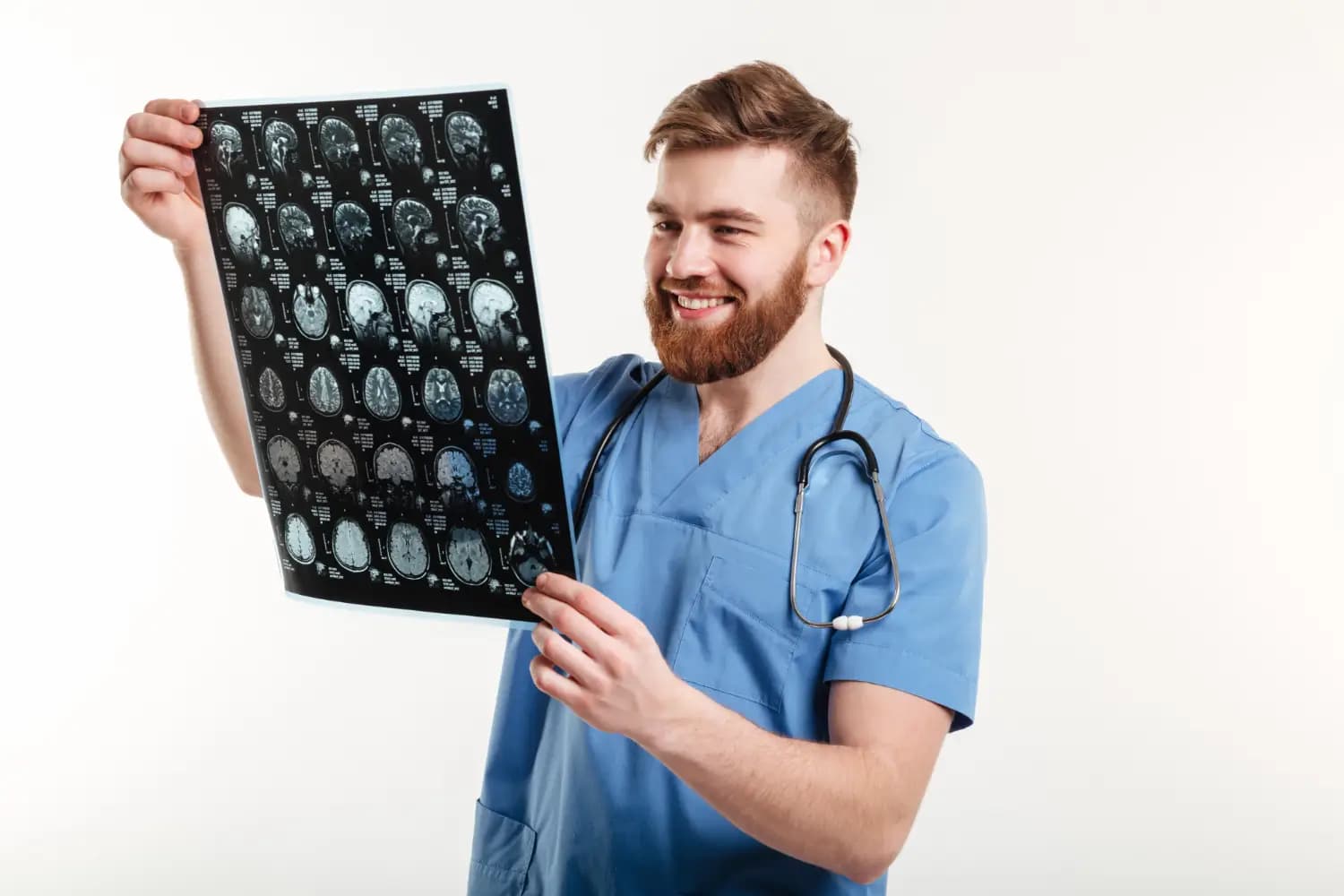

Many patients come to a neurological examination with concerns or uncertainty. We would therefore like to explain what you can expect and how to prepare for your visit.
What does a neurologist do?
A neurologist deals with diseases of the brain, spinal cord, nerves, and muscles. Our role is not only to establish a diagnosis, but above all to understand the cause of your difficulties, explain it in an understandable way, and suggest a solution that may help improve your quality of life. We continuously educate ourselves and follow new medical knowledge so that we can offer patients modern, expert care.
The most common neurological difficulties
We examine and treat a wide range of difficulties, including:
- headaches and migraines,
- back pain,
- dizziness,
- sensory disturbances,
- weakness of the limbs,
- memory problems,
- epilepsy,
- Parkinson's disease and other movement disorders,
- tremor and involuntary movements,
- neuropathies,
- other neurological conditions.
Neurology clinic at Polyclinic Púpava
At our neurology clinic, patients are cared for by:
How should you prepare for a neurological examination?
The most important part of a neurological examination is the conversation. The information provided by the patient often gives us the most important details for establishing the correct diagnosis. It is therefore very useful to prepare a brief list of questions or points you would like to discuss during the visit.
Prepare information about:
- your difficulties and how they have developed,
- conditions for which you are being treated,
- all medications you are taking,
- allergic reactions to medications or other substances,
- neurological conditions in your family,
- previous examinations or hospitalizations.
What should you bring to the examination?
It is useful to have an overview of the medications you take, including dosages, and to be able to provide information about previous examinations or treatment. If you use glasses, a hearing aid, or walking aids, please bring them with you.
A record of symptoms can be helpful
If you have involuntary movements, tremor, twitches, episodes of dizziness, or other symptoms that do not occur constantly, it may be helpful to bring a short video or photograph showing the problem.
You may also come accompanied
If you wish, you may come with a close person. In some conditions, such as memory disorders or Parkinson's disease, information from family members can be valuable. Of course, if needed, you may also bring your children into the clinic.
What happens during a neurological examination?
A neurological examination begins as soon as you arrive at the clinic. The doctor may observe the way you walk, your posture, movements, facial expression, and overall behavior.
Because a neurologist examines the nervous system and its functions, the examination often focuses on several parts of the body. In most cases, examination in underwear is necessary so that posture, muscle trophism, possible asymmetries, spinal deformities, skin changes, limb position, and movement patterns can be thoroughly assessed without clothing limiting the examination. We therefore ask patients to expect this part of the examination and to wear suitable underwear in which they will feel comfortable.
What do we assess during the examination?
- muscle strength,
- reflexes,
- sensation,
- coordination and precision of movement,
- balance and gait,
- eye movements,
- speech,
- cranial nerve function,
- memory, attention, and other cognitive functions.
Examination according to the type of difficulty
We always adapt the examination to the specific problem. Every patient is different, so we try to look at difficulties in a broader context.
For back pain
We focus mainly on the spine, nerve roots, and musculoskeletal system.
For headaches
We try to determine the type of pain and identify any warning signs that may require further examinations.
For memory problems
We may use tests, questionnaires, and rating scales.
For Parkinson's disease and movement disorders
We assess gait, balance, tremor, muscle stiffness, and fine motor skills in detail.
Additional examinations
If needed, we may recommend further examinations, such as:
- blood tests,
- X-ray examination,
- computed tomography (CT),
- magnetic resonance imaging (MRI),
- electromyography (EMG),
- electroencephalography (EEG),
- or other specialized examinations.
Treatment options
Based on the results, we propose an individual treatment plan. We may adjust or start medication, recommend rehabilitation, physiotherapy, infusion therapy, injections, or other therapeutic procedures.
Modern preventive treatment options for migraine are now available for some types of headaches. In Parkinson's disease, appropriately adjusted therapy can often reduce symptoms and support quality of life.
What can you expect after the examination?
After the examination, the doctor will explain the findings and recommend the next steps. In some cases, it is possible to establish a diagnosis and start treatment immediately; in others, additional examinations are needed. You may receive recommendations regarding medication, rehabilitation, lifestyle changes, or a follow-up examination. If something is unclear, do not hesitate to ask about the next steps, the expected course of treatment, or possible alternatives.
Cooperation with other specialists
We also work closely with other specialists:
- physiotherapists for back pain, stability disorders, and movement training,
- ENT doctors for dizziness,
- psychiatrists and psychologists for memory, mood, or behavioral disorders,
- other specialists as needed.
In more complex cases, we may recommend consultation or examination in specialized centers and university departments.
In conclusion
We believe that good medicine is based not only on expertise, but also on mutual communication and trust. Do not be afraid to ask questions. Your questions are important, and we will gladly discuss the examination results, possible causes of your difficulties, and available treatment options with you.
A neurological examination helps clarify the cause of your difficulties, provides understandable information, and determines the next appropriate steps in care.
MUDr. Petra Paveleková